
How Much Does a Website Redesign Cost in 2026? (Planning Guide)
Refresh, redesign, or rebuild? Indicative budget ranges, six factors that change a quote, SEO migration risks, hidden costs, and three clearly labelled illustrative redesign scenarios.
 Ali RehmanFreelance Web Developer
On this page 11 sections
"We just need a refresh - what would that run us?" is one of the most common messages I get as a freelance developer. And the honest answer frustrates people: anywhere from $800 to $30,000. That is not evasion - it is because "redesign" describes at least three very different projects, and most business owners asking for quotes do not yet know which one they actually need. That confusion is exactly how companies end up paying rebuild prices for what should have been a refresh.
This guide breaks down indicative redesign budgets by project type and platform, six factors that change a quote, SEO migration risks, and three illustrative scenarios. The figures are planning assumptions, not a market survey, fixed quotes or documented client results. If you are still deciding whether your site needs a redesign at all, start with my guide on the 9 signs it's time to redesign your website - this article covers what happens after that decision: the money.
First: Refresh, Redesign, or Rebuild? (They Cost Very Different Money)
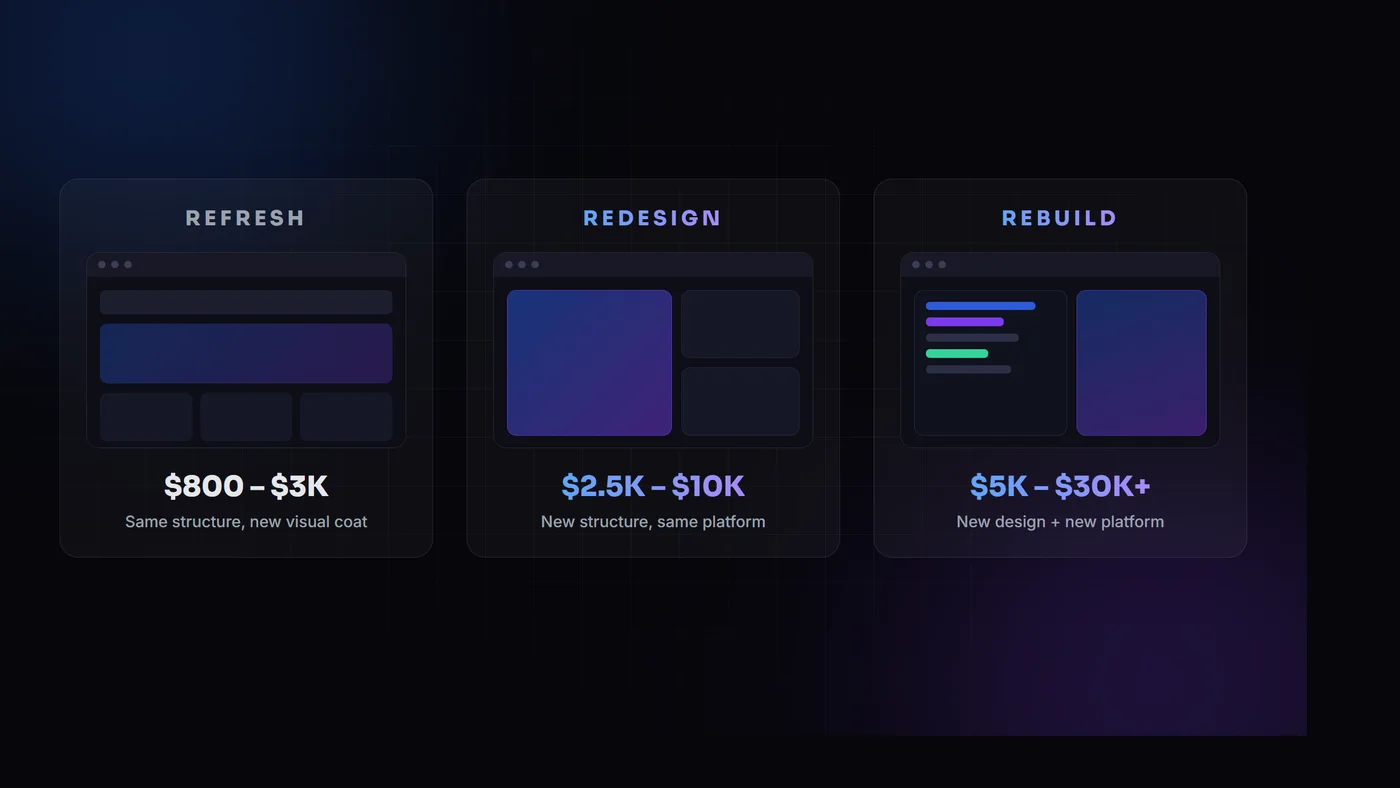
Tier 1: The refresh - $800 to $3,000
Same structure, same platform, same content - new visual coat. Updated colours, typography, spacing, imagery, a modernised homepage, maybe a new logo dropped in. A refresh makes sense when the bones of your site are healthy: it loads fast, works on mobile, and ranks reasonably, but it looks like it was built five years ago. Visitors judge a site's credibility in a fraction of a second, so if dated design is your only real problem - and my checklist of signs your website is losing you customers can help you confirm that - a refresh is the highest-ROI option on this list.
Tier 2: The true redesign - $2,500 to $10,000
New information architecture, new page layouts, rewritten key pages, new design system - built on your existing platform. This is the right scope when the site's structure is the problem: visitors cannot find things, the pages do not match how you sell today, or the site was built for a business you have since outgrown. Content strategy usually enters here too; a redesign that reuses weak copy is a repaint of a house with a cracked foundation, which is why I usually pair this tier with the principles from my guide on writing website content that converts.
Tier 3: Redesign + rebuild - $5,000 to $30,000+
New design and new technology: moving from a page builder to WordPress, from an old theme to a custom build, or from WordPress to a modern stack like Next.js. You are paying for two projects at once - design and engineering - which is why the number jumps. The trade-off maths is covered in depth in my WordPress vs custom website comparison, but the short version: rebuilds make sense when the current platform actively blocks you - the site is painfully slow, insecure, impossible to edit, or cannot support the features you need next.
Website Redesign Cost by Business Type
- Simple brochure site (5-8 pages, service business): refresh $800-$2,000 · full redesign $2,500-$5,000
- Growing business site (10-25 pages, blog, lead forms): full redesign $4,000-$10,000
- Ecommerce store (Shopify / WooCommerce): re-theme $2,000-$6,000 · full redesign $6,000-$20,000
- Web app or SaaS interface: UI redesign $5,000-$25,000+ (scope behaves like development - see my web app cost guide)
- Content/publisher site (100+ pages): $8,000-$25,000, driven almost entirely by migration and SEO care
Two of these deserve a note. Ecommerce redesigns cost more because every template touches revenue - product pages, cart, checkout - and mistakes show up immediately in sales, so testing has to be thorough; my ecommerce website cost guide breaks down where that money goes. And if your "website" has logins, dashboards, or user data, you are really pricing software design - the ranges in my web app development cost breakdown will serve you better than brochure-site numbers.
The 6 Factors That Actually Move a Redesign Quote
- 1Page count and templates. Designers price by unique layouts, not total pages. A 40-page site with 6 templates costs less than a 15-page site where every page is custom.
- 2Platform change. Staying on your CMS keeps costs down; switching platforms adds migration, redirects, retraining, and risk - often 40-60% of the total.
- 3Content migration and rewriting. Moving 200 blog posts cleanly, or rewriting every service page, is real labour that quotes often hide until later.
- 4Design depth. Template-based design ($) vs custom design system ($$) vs custom design with animation and art direction ($$$).
- 5SEO preservation. Redirect mapping, metadata carry-over, and performance budgets. Cheap quotes skip this - and it is the most expensive thing to skip.
- 6Integrations and features. Booking systems, CRMs, payment flows, multilingual support - each adds design states and engineering time.
The Part Nobody Warns You About: A Redesign Can Nuke Your SEO
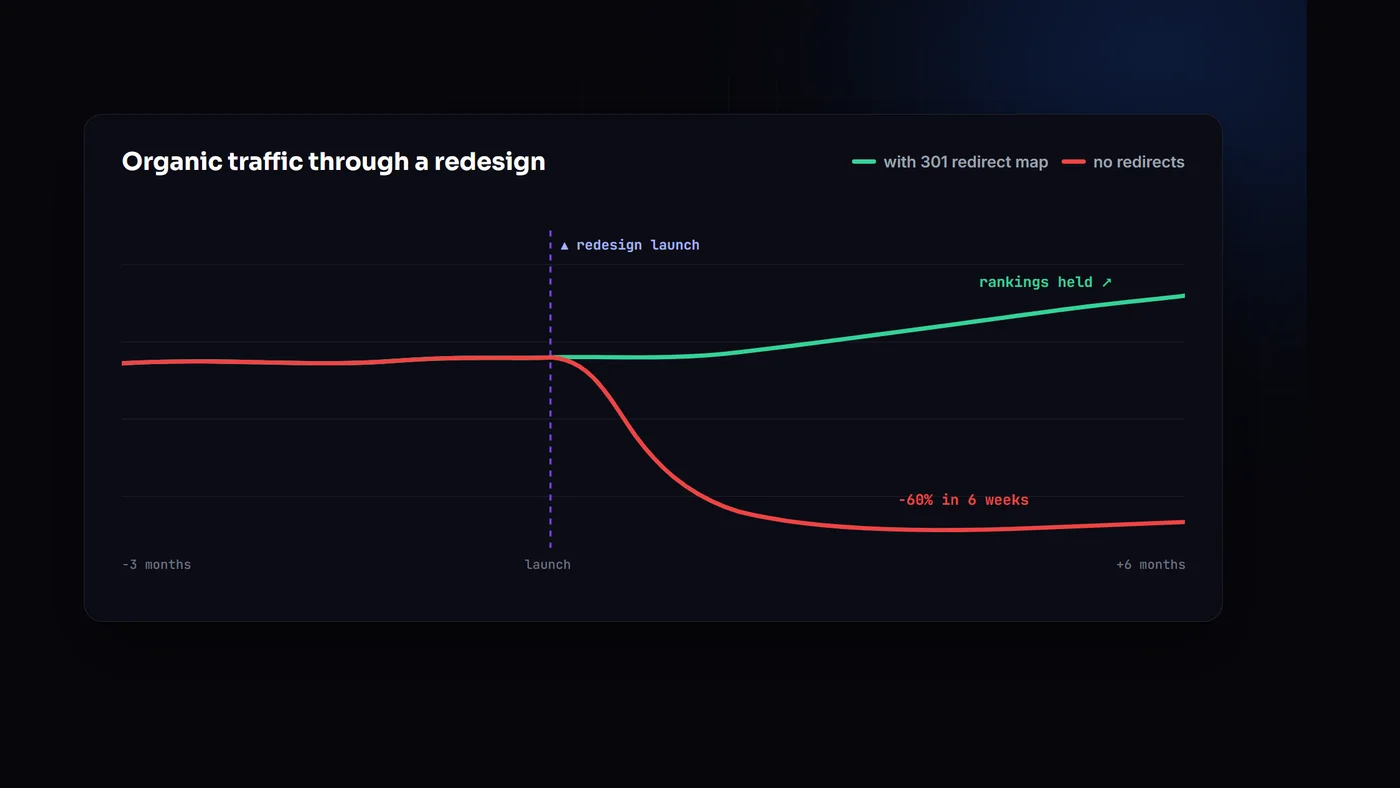
Here is the scenario I get called in to fix a few times every year: a business launches a beautiful new site, and within six weeks their Google traffic has fallen off a cliff. The redesign changed URLs without redirects, dropped keyword-rich copy from key pages, or shipped a slower site - and Google quietly re-evaluated everything. If your traffic has already gone strange after a redesign, my guide on why a website stops showing up on Google walks through the diagnosis step by step.
A professional redesign protects rankings with four unglamorous deliverables: a full URL inventory with 301 redirect mapping, preserved titles and meta descriptions on every page that ranks, equal-or-better page speed on the new build (Core Web Vitals are a ranking signal - my website speed guide explains which metrics matter), and a crawl of the new site before launch to catch broken links and blocked pages. None of this is visible in a design mockup, which is exactly why the cheapest quote usually omits it. Ask every candidate: "What is your redirect and SEO-preservation plan?" If the answer is vague, the real cost of that quote is your organic traffic. For the full pre-launch list, see my technical SEO checklist.
Redesign vs Starting Over: Which Is Cheaper?
Counter-intuitive but true: past a certain point of mess, a fresh build is cheaper than a redesign. Reworking a site means carrying its baggage - old plugins, tangled code, workarounds stacked on workarounds - and every hour spent untangling is an hour not spent building. My rule of thumb after years of both: if the redesign quote crosses about 70% of a new-build quote, or the current platform fights every change you want, start fresh. A new build also resets your cost baseline - the ranges in my complete website cost guide show what starting over actually runs in 2026, and it is often less than owners fear.
The reverse is also true: do not rebuild what only needs paint. If the site is fast, ranks well, and converts adequately, a $2,000 refresh this year beats a $12,000 rebuild you did not need. The skill is matching the project to the actual problem - which is precisely the first conversation I have with anyone who sends me their site for an honest assessment.
Who Does the Work: Freelancer, Agency, or DIY?
- DIY page-builder refresh: $0-$500 in tools. Fine for a placeholder; risky for a business that lives on leads - one wrong template change can hurt mobile UX or speed without you noticing.
- Freelance designer/developer: $800-$10,000 for most redesigns. Direct communication, one accountable person, and the person quoting is the person building.
- Agency: $10,000-$50,000+. Adds project managers, strategy workshops, and process - worth it for large organisations, overkill for most small businesses.
The pattern from my website cost guide holds here: agencies charge two to four times freelancer rates for comparable scopes, and the difference is overhead more than output. Whoever you choose, vet them the same way - live sites they redesigned (before and after), what happened to those sites' traffic post-launch, and a written scope. My guide on how to hire the right web developer includes the exact questions and the red flags that predict a project going sideways.
Hidden Costs That Surprise People
- Content rewriting: $50-$150 per page professionally - the line item everyone forgets and the one that most affects conversions.
- Photography and imagery: $300-$1,500 for a real shoot; stock photos of handshakes cost less and convert worse.
- Redirect implementation and testing: $200-$800 on larger sites - cheap insurance for your rankings.
- Plugin/app re-licensing: platform switches can orphan tools you paid for.
- Post-launch fixes: budget 5-10% of project cost for the two weeks after launch - something always surfaces.
- Ongoing care: a redesigned site still needs updates and monitoring - real numbers in my website maintenance cost guide.
That last item matters more than it looks: an unmaintained redesign starts drifting toward "needs another redesign" the day it launches. A modest monthly plan - the kind I detail in my maintenance cost breakdown - stretches the life of a redesign from three years to six or more, which quietly halves its real annual cost.
How to Keep Redesign Costs Down (Without Regretting It)
- 1Diagnose before you shop. Know whether you need a refresh, redesign, or rebuild - quotes for the wrong tier waste everyone's time.
- 2Keep your platform if it is not the problem. Platform switches are where budgets double.
- 3Reduce unique templates. Six well-designed templates can carry a 50-page site.
- 4Write (or budget for) content early. Design around real copy, not lorem ipsum - it prevents expensive layout rework.
- 5Phase it: redesign the money pages first (home, services, contact), roll the rest out monthly.
- 6Demand the SEO-preservation plan in the written scope, not as a verbal promise.
- 7Get a fixed quote against that written scope - hourly redesigns on vague scopes are how $4,000 becomes $11,000.
Illustrative redesign budgets (not client case studies)
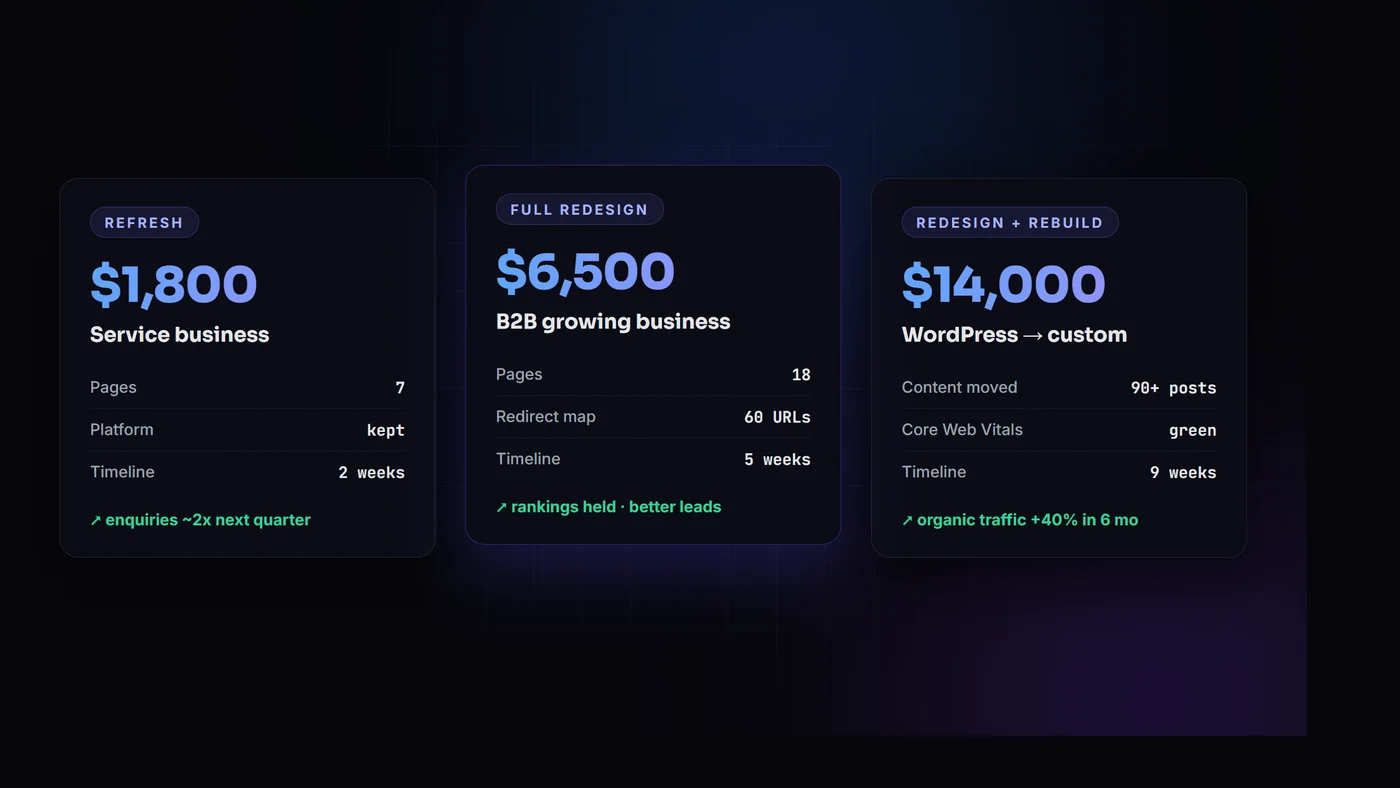
Illustrative scenario 1: Service business refresh - $1,800
Illustrative scope: a structurally sound 7-page local services site needs a visual refresh. Apply a new design system to existing pages, optimise imagery, clarify the homepage call-to-action and address measured loading issues. Assume a $1,800 planning budget and about two weeks with content ready and prompt approvals. This is not a delivered client project or an enquiry-growth claim; establish an analytics baseline and test the contact journey before evaluating any benefit.
Illustrative scenario 2: Growing business redesign - $6,500
Illustrative scope: redesign an 18-page B2B site on its existing CMS, review navigation, rewrite five service pages and add a template for genuine case studies. Include a redirect map for 60 old URLs and a page-by-page metadata review. Assume $6,500 and about five weeks for planning, subject to content and technical discovery. Test redirects and monitor search visibility after launch; neither preserved rankings nor improved lead quality is an observed result of this hypothetical scenario.
Illustrative scenario 3: Redesign + platform rebuild - $14,000
Illustrative scope: migrate a plugin-heavy WordPress site with more than 90 blog posts to a custom build. Include a design system, cleaned content migration, a complete URL and redirect inventory, and performance testing. Assume a $14,000 budget and about nine weeks with the migration scope agreed in advance. Core Web Vitals are targets to measure on the completed site, not proven results; this scenario reports no traffic increase and makes no ranking guarantee.
Website Redesign Cost: FAQ
How much does a website redesign cost for a small business?
Most small-business redesigns land between $2,500 and $7,000 with a freelancer in 2026. A visual-only refresh can be as little as $800-$2,000, while adding a platform change pushes the project to $5,000-$15,000+. Agencies typically charge two to four times these figures for the same scope.
Is it cheaper to redesign a website or build a new one?
A redesign is cheaper when the platform and content are healthy. A new build wins when the redesign quote approaches 70% of new-build cost, or when the current platform is slow, insecure, or blocks the features you need. Carrying technical baggage costs real hours - sometimes more than starting clean.
How long does a website redesign take?
A refresh takes 1-3 weeks, a full redesign 4-8 weeks, and a redesign with a platform rebuild 6-12 weeks. Content readiness is the most common delay - copy that arrives late stalls projects more often than design or code does.
Will redesigning my website hurt my SEO?
Only if it is done carelessly - but then it can hurt badly. Rankings survive redesigns when every old URL 301-redirects to its new home, page titles and content that rank are preserved, and the new site is at least as fast as the old one. Ask any developer you interview for their redirect and SEO-preservation plan before signing.
How often should a website be redesigned?
Every 3-5 years is typical, but the calendar is the wrong trigger. Redesign when the site stops doing its job: falling conversions, rising mobile complaints, a design that undercuts your credibility, or a platform that fights every update. A maintained site ages far slower than a neglected one.
Can I just redesign my website myself?
For a hobby site, yes. For a business site, be careful: modern templates make things look decent, but the money problems - speed, mobile UX, redirects, SEO carry-over - live under the surface where templates cannot help. A safe middle path is doing content yourself and hiring a professional for structure, performance, and launch.
The Bottom Line
A website redesign in 2026 costs $800-$3,000 for a refresh, $2,500-$10,000 for a true redesign, and $5,000-$30,000+ when a rebuild is involved - with ecommerce and web apps at the top of each band. The quote is driven by templates, platform changes, migration, and SEO care far more than by how pretty the design is. Match the project tier to your actual problem, insist on a written scope with an SEO-preservation plan, and phase the work if budget is tight. Done that way, a redesign is not an expense - it is the cheapest growth lever a site that has fallen behind can pull.
Written by
Ali Rehman - Freelance Web Developer
I work on WordPress websites, practical fixes and scoped web applications. Read my background and skill scope, or send a project brief to discuss a written plan and quote - start here.
More articles by Ali Rehman →