
How to Hire the Right Web Developer for Your Business (2026 Guide)
Hiring a web developer is a big decision. This guide shows exactly what to look for, the questions to ask, and the red flags to avoid - so you get a site that actually works.
 Ali RehmanFull Stack Web Developer
On this page 12 sections
Hiring the wrong web developer is expensive - in money, time and sheer stress. Hiring the right one feels almost effortless: clear communication, work that ships on time, and a website that actually grows your business instead of just sitting there. The difference between those two outcomes is rarely luck. It comes down to knowing what to look for before you commit - and that’s exactly what this guide gives you.
Whether you’re a small business owner getting your first real site, or you’ve been burned by a bad experience before, this is the practical checklist I’d want a friend to use. If you haven’t settled on a budget yet, pair this with my breakdown of how much a website really costs in 2026, and if you already know what you need, you can see how I work on my services page.
Why choosing the right developer matters so much
Your website is often the first - and sometimes only - impression a potential customer gets. A developer doesn’t just “make it look nice”; they decide how fast it loads, whether it works on phones, whether Google can find it, and whether visitors actually turn into leads. Get that right and the site pays for itself many times over. Get it wrong and you inherit a slow, hard-to-edit site that’s quietly costing you business - the exact problems I cover in 7 signs your website is losing you customers. Redoing a botched project almost always costs more than doing it properly the first time.
Freelancer vs. agency vs. cheap marketplace

There are three common routes, and each has genuine trade-offs. The right choice depends on your budget, the complexity of your project, and how much you value working directly with the person doing the work.
- Agencies - more capacity and a whole team, but higher prices. You often deal with an account manager rather than the person actually building your site, which can slow decisions and dilute your vision.
- Cheap marketplaces - tempting prices, but wildly inconsistent quality and communication. Too often you receive a generic template with your logo dropped on top, and support disappears the moment you’ve paid.
- A skilled independent freelancer - you work directly with the person doing the work. That means faster decisions, personal accountability, and usually the best value for money, because you’re not paying for layers of overhead.
For most small and medium businesses, a dedicated freelancer hits the sweet spot: agency-level quality without agency-level pricing, and a direct line to the person who actually knows your project inside out. The key word is skilled - the checklist below is how you separate the professionals from the rest.
What to look for in a good developer
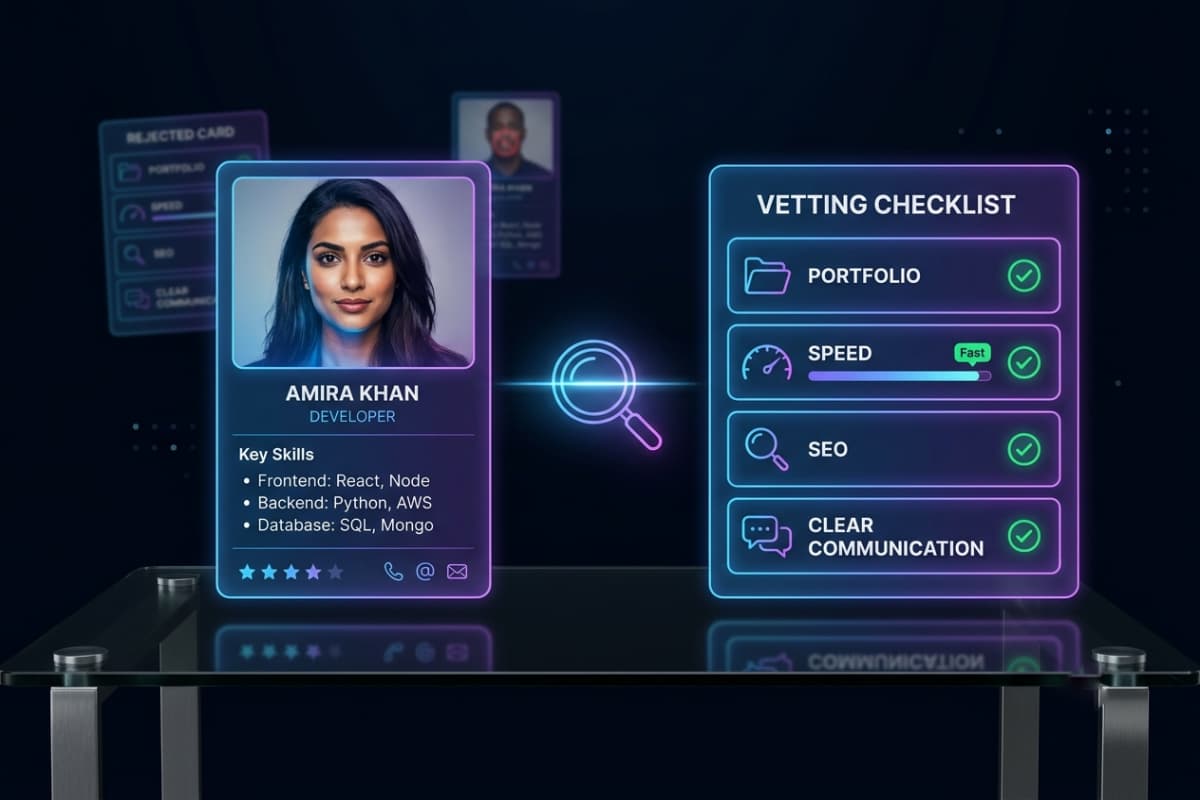
- A real portfolio of live sites you can actually visit and click around - not just polished screenshots.
- Modern, fast technology such as React and Next.js, rather than outdated, bloated page builders.
- A clear focus on speed, mobile experience and SEO - not just how the design looks in a mockup.
- Clear, written communication and honest timelines, even when the honest answer isn’t what you want to hear.
- A willingness to provide a fixed quote and a documented scope so you both know exactly what’s included.
Technical skill matters, but communication is what makes or breaks a project. A brilliant developer who never replies is worse than a good one who keeps you informed. Look at how they respond during your very first conversations - that’s a preview of the whole working relationship. You can get a feel for the standard to expect by browsing my own portfolio of live projects.
Questions to ask before hiring

- 1Can I see live examples of your recent work - actual URLs I can visit?
- 2Will the site be fast and mobile-friendly, and can you show me the performance scores?
- 3Will I be able to edit content myself after launch, or do I have to come back to you for every change?
- 4What exactly is included in the price - and what costs extra?
- 5What happens if something breaks after launch? Is there any support period?
- 6Who owns the code and the accounts once the project is done?
The answers tell you as much as the words. A professional will answer clearly and confidently; someone to avoid will get vague or defensive. Pay special attention to the ownership question - you should always end up owning your domain, your code and your hosting accounts.
Red flags to avoid

- No portfolio, or only screenshots with no live links you can verify.
- Vague pricing and a “we’ll figure the cost out later” attitude.
- Slow or unclear replies before you’ve even paid - it rarely improves afterwards.
- Promises that sound too good to be true (“#1 on Google in a week”).
- No mention of speed, SEO or mobile - a sign they think of a website as decoration, not a tool.
- Pressure to pay everything upfront with no milestones or written agreement.
Trust your instincts here. If something feels off during the sales conversation - when they’re supposedly on their best behaviour - it will almost certainly feel worse once money has changed hands.
Green flags: signs you've found the right one
Red flags tell you who to avoid; green flags tell you when to say yes. The best developers share a handful of reassuring habits that show up early - often before you’ve paid a penny:
- They ask questions about your business, not just your design preferences - because the goal is results, not decoration.
- They’re happy to put everything in writing and send a documented scope without being chased.
- They talk about speed, mobile and SEO unprompted, and can explain them in plain English.
- They set realistic expectations - including telling you when something isn’t worth doing.
- Their own portfolio sites are fast, modern and genuinely pleasant to use.
When you see most of these, you’ve likely found someone worth working with. A developer who cares about your outcomes - not just shipping something and moving on - is exactly who turns a website into a business asset.
What a great developer will ask you
Hiring is a two-way street. A professional won’t just take an order; they’ll want to understand your goals so the finished site actually serves them. Expect thoughtful questions like: Who are your customers? What action do you want visitors to take? What’s working (and not) with your current site? Do you have branding and content ready? If a developer asks none of these and jumps straight to “send me the pages,” be cautious - they’re building a template, not solving your problem. Curiosity about your business is one of the strongest signals you’ve found the right person.
How to check a portfolio properly
A portfolio is only useful if you know how to read it. Don’t just glance at the thumbnails - actually open the live sites and test them the way a customer would:
- Open two or three sites on your phone and see if they’re genuinely easy to use.
- Notice how fast each one loads - a slow portfolio site is a bad sign.
- Run a page through Google’s PageSpeed Insights if you want hard numbers.
- Look for variety and depth - can they build more than one type of site?
- If the work involves custom features (logins, dashboards, e-commerce), ask them to walk you through one.
Ask a developer to explain their role in client work and distinguish completed implementations from work in progress. My experience includes developing client projects through an agency, separate from the personal work in my portfolio. Softora Guide is an independent implementation; Foliora People and Indexloom Audit are personal projects in progress, currently at the interface-preview and planning stage. A polished image alone is not proof of a working backend, tested security controls or client results.
Understanding quotes, scope and contracts
Before any money changes hands, get the scope in writing. A good quote spells out what’s included, what isn’t, the timeline, and how payment is split (typically a deposit and one or more milestones). Prefer a fixed price against a clear scope over open-ended hourly billing - it protects your budget and removes nasty surprises. I explain the difference in detail in the website cost guide, but the short version is: clarity upfront prevents disputes later.
Working without endless meetings
Here’s something many business owners appreciate but rarely ask about: you don’t need constant phone calls to get a great website. A lot of the best project work happens asynchronously and in writing - clear briefs, written updates, and a shared document trail you can refer back to. This suits busy owners across different time zones, and it means every decision is recorded rather than half-remembered from a call. It’s exactly how I run projects: written scope, written updates, and messaging on your schedule - no pressure to jump on a call.
Where to find reliable developers
Referrals are gold - if someone you trust had a great experience, start there. Beyond that, platforms like Upwork, Fiverr and LinkedIn work well if you vet carefully using the checklist above. Focus relentlessly on live work samples and clear communication rather than chasing the lowest price. The cheapest quote is almost never the best value, and the most expensive isn’t automatically the best either.
Frequently asked questions
How much should I pay a web developer?
It depends on scope, but a custom business website typically runs $1,500 - $4,000, while landing pages start lower and web apps run higher. I break the full picture down in how much a website costs in 2026.
Should a small business hire a freelancer or an agency?
For most small businesses, a skilled freelancer offers the best balance of quality, cost and direct communication. Agencies make more sense for very large projects that need a big team working in parallel.
What if I can't do phone calls or we're in different time zones?
That’s completely fine - and often better. Plenty of excellent project work is done entirely through written briefs and messages, which keeps a clear record of every decision. Look for a developer who communicates well in writing, as I do.
How do I know if a developer is actually any good?
Visit their live sites, test them on your phone, check how fast they load, and notice how clearly and quickly they communicate before you’ve paid. Those four signals tell you almost everything.
How long does it take to get started?
A good developer can usually scope your project and give you a fixed quote within a few days. Once you approve it and share your content, a landing page can be live in days and a full business site in a matter of weeks - so it pays to reach out before you urgently need the site finished.
If you’d like to work with someone who ticks every box on this list - live portfolio, modern tech, fixed quotes and clear written communication - take a look at my web development services, explore my recent projects, or send me a message to talk through your idea. No calls required, everything in writing.
Written by
Ali Rehman - Full Stack Developer
I build fast, scalable web applications with React, Next.js, Node.js & TypeScript. Have a project in mind? Send me a message and get a written plan with a fixed quote - start here.
More articles by Ali Rehman →