
Landing Page vs Website: Which One Does Your Business Actually Need? (2026)
A landing page sells one thing to one audience; a website builds trust and ranks on Google. The honest 2026 breakdown: real costs, when you need each (or both), conversion benchmarks, and the 7 mistakes that quietly burn ad budgets.
 Ali RehmanFreelance Web Developer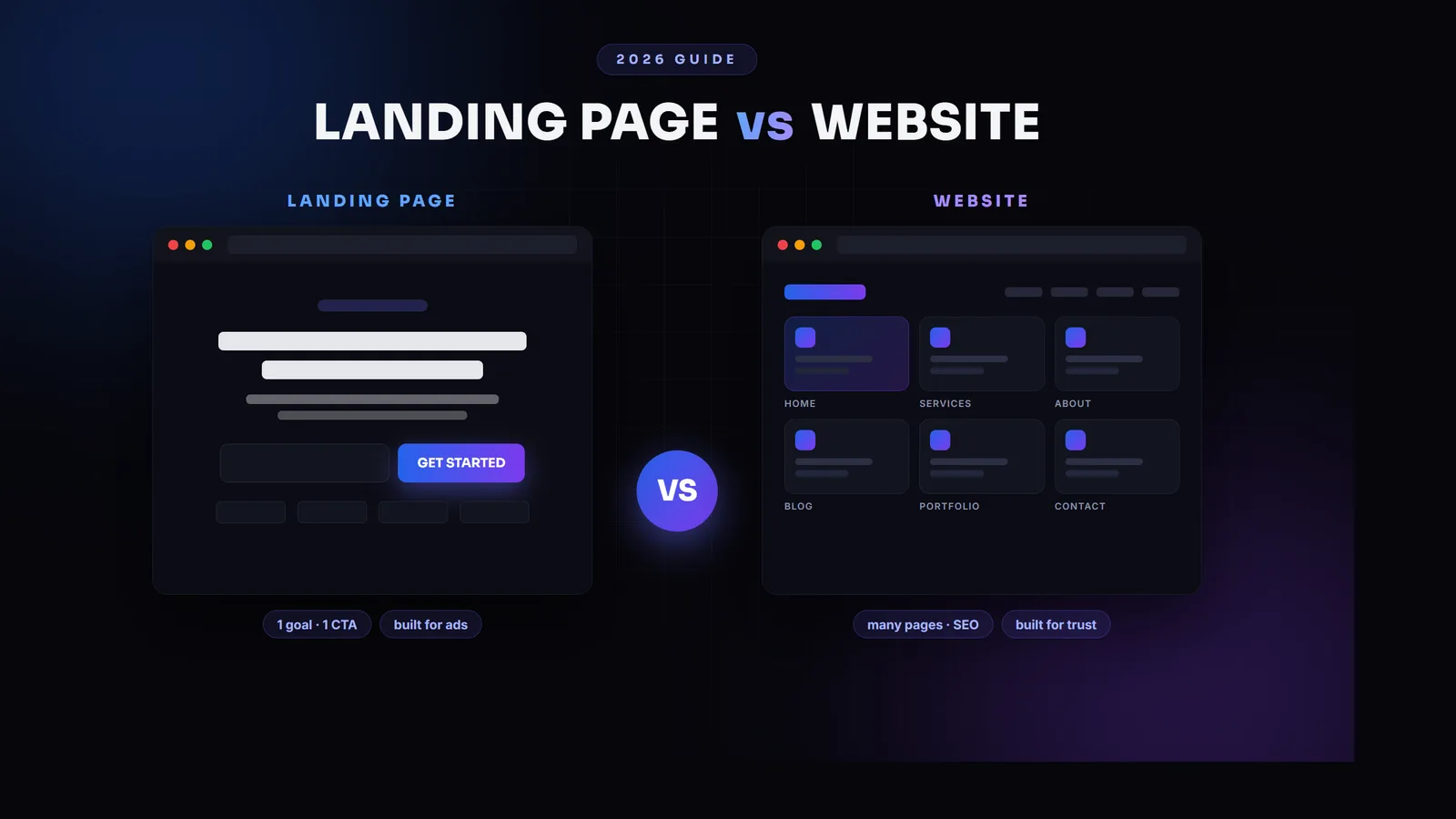
On this page 11 sections
You are about to spend money - on Google Ads, a product launch, or your first real online presence - and you have heard two conflicting pieces of advice. One person says "you just need a landing page, websites are overkill." Another says "a landing page is not a real business presence, build a proper website." Both sound confident. Both are sometimes right. This guide gives you the honest answer: what each one actually is, what they cost in 2026, when you need one, the other, or both - and the expensive mistakes I see business owners make when they pick wrong.
What Is a Landing Page (and How Does It Actually Work)?
A landing page is a standalone web page built for exactly one goal: convert a specific visitor into a lead or customer. Someone clicks an ad, an email link or a social post, "lands" on the page, and is asked to do one thing - book a call, start a trial, download a guide, buy a product. That is the entire job. No menu of options, no "learn more about us", no ten different paths to wander down.
A good landing page is ruthlessly focused. The headline repeats the promise of the ad that brought the visitor (marketers call this message match). The copy handles objections. Social proof - reviews, logos, results - builds just enough trust. And a single call-to-action appears again and again. That is why high-performing landing pages usually remove the site navigation entirely: every extra link is an exit door, and exit doors kill conversions.
- One goal, one call-to-action (repeated down the page)
- Traffic arrives from ads, emails or social - not from Google search
- Navigation is stripped out so the visitor either converts or leaves
- Headline and offer mirror the exact ad the visitor clicked
- Built per campaign or per audience - not as a permanent home
What Is a Website (and What Does It Do That a Landing Page Can't)?
A website is your permanent home on the internet - a connected set of pages that lets a stranger become a customer at their own pace. The homepage orients people. The services or product pages explain what you sell. The about page answers "who am I dealing with?". The contact page makes reaching you easy. And research consistently shows buyers visit several pages before they trust a business enough to inquire - that journey simply cannot happen on a single, navigation-free page. I covered when a business genuinely needs one (and when social media is enough) in my guide on whether you still need a website in 2026.
The other thing only a website can do: rank on Google. Organic search traffic compounds - a services page or blog article you publish once can bring visitors for years without ad spend. Landing pages almost never do this, because they are thin by design and usually target paid traffic. If long-term, free traffic matters to your business model, that is a website job - and it needs the fundamentals right, which I break down in my technical SEO checklist and in why websites fail to show up on Google.
Landing Page vs Website: The 6 Core Differences
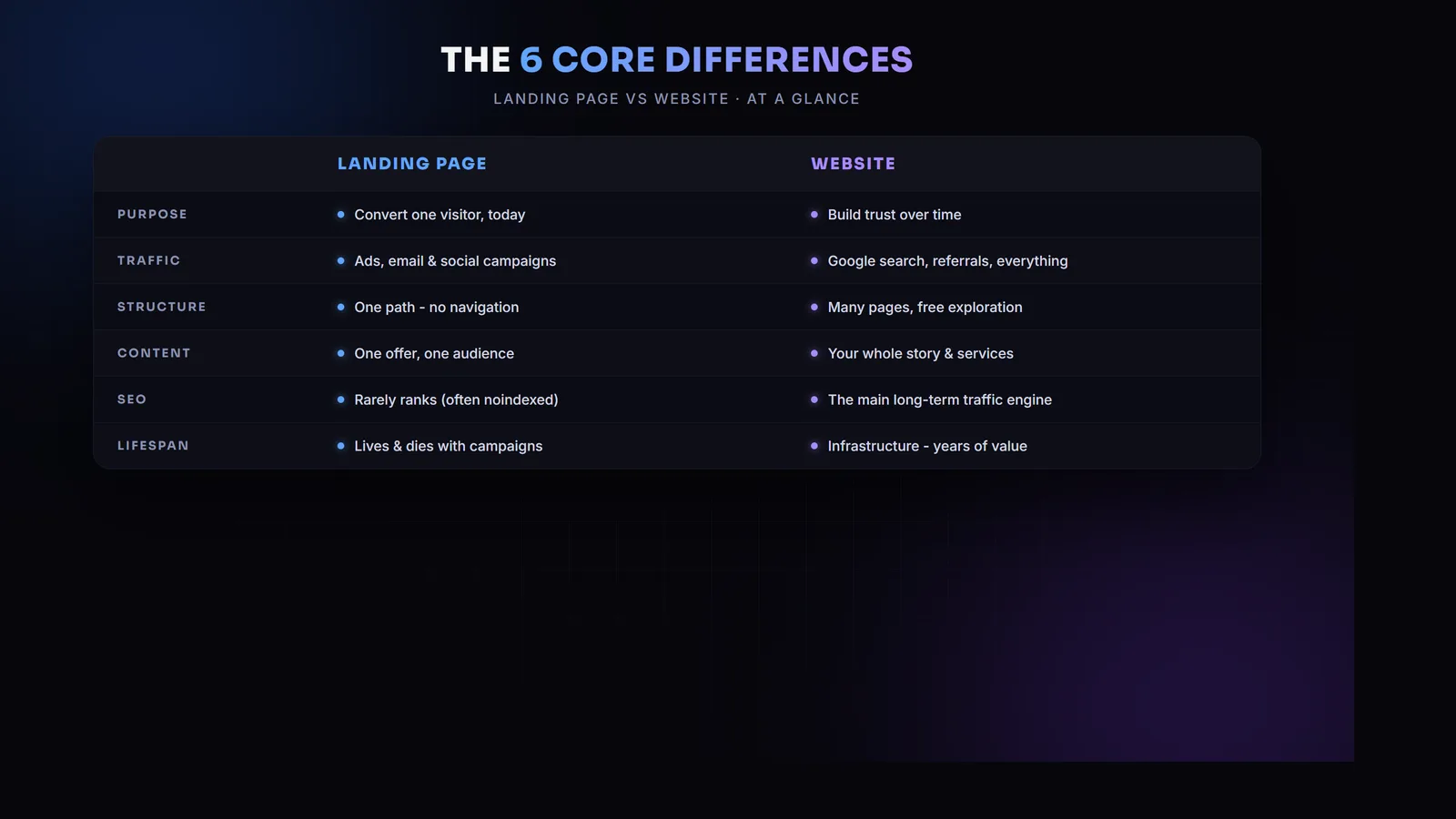
People treat these as interchangeable because both are "web pages". They are not. They differ on purpose, traffic, structure, content, SEO and lifespan - and once you see the six differences side by side, choosing gets much easier.
1. Purpose: convert now vs build trust over time
A landing page exists to convert a visitor today. A website exists to inform, reassure and nurture - it converts too, but it also has to survive the "let me check them out first" visit, the price-comparison visit, and the referral visit from someone who was told "look this company up".
2. Traffic source: campaigns vs everything
Landing pages receive traffic you paid for or engineered: Google Ads, Meta ads, email blasts, influencer links. Websites receive everything else: Google search, word of mouth, social profiles, invoices, business cards, press. If you stop paying, landing page traffic stops; website traffic keeps arriving.
3. Structure: one path vs exploration
A landing page is a corridor - one way in, one door out (the CTA). A website is a building with rooms. Neither structure is "better"; they are built for different visitor intents. Ad-clickers want the corridor. Researchers want the building.
4. Content: one offer vs your whole story
Landing page copy is narrow and persuasive - one offer, one audience, objections handled in order. Website copy is broader: every service, your process, your portfolio, FAQs. Writing that converts is its own skill either way - I shared the exact frameworks in how to write website content that converts.
5. SEO: an afterthought vs the main event
Most landing pages should not even try to rank - they are short-lived, thin, and duplicated per campaign (many teams deliberately noindex them). A website is the opposite: its entire long-term value is compounding visibility on searches your customers already make.
6. Lifespan: weeks vs years
Landing pages live and die with campaigns - you spin them up, test variants, and retire the losers. A website is infrastructure: built once, maintained and improved for years. That difference alone explains most of the cost gap between the two.
Do You Need a Landing Page, a Website, or Both?
A landing page alone is enough (for now) if...
- You are validating a new idea and need a waitlist or pre-orders before investing further
- You sell exactly one thing to one audience (a course, an event, a single service package)
- All of your traffic will come from ads or an existing audience - none from Google search
- You need to be live this week and can grow into a full site later
And yes - you can have a landing page without a website. It is a legitimate starting point, not a hack. Plenty of successful products launched on a single page with a form. The trap is staying there after your business outgrows it: the moment people start Googling your name, comparing you to competitors, or asking "do you also do X?", a lone landing page starts costing you the customers who wanted to research first.
You need a full website if...
- You are a service business where trust decides the sale (clients research before contacting)
- You want organic Google traffic - including local searches like "web developer near me"
- You offer multiple services or products that deserve their own pages
- Partners, press or B2B buyers will look you up before taking you seriously
For local businesses this is even more direct: Google's local results pull heavily from your website's content and structure. A landing page cannot carry that weight - I explained the full playbook in my guide to local SEO for small businesses. And if budget is the worry, a lean but proper business website costs far less than most owners assume - I published real numbers in how much a website costs in 2026.
You need both if you run ads (this is where most money is wasted)
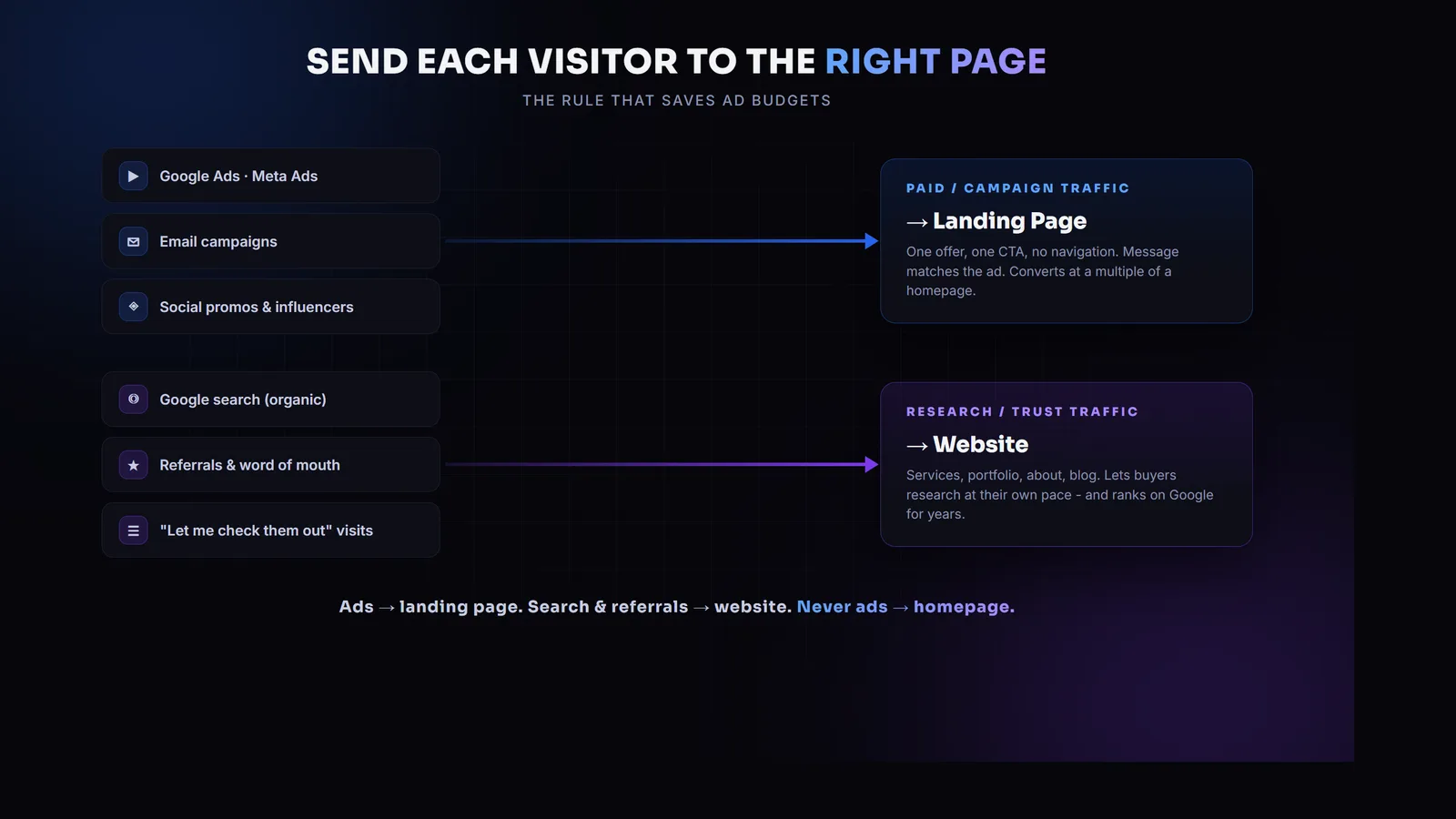
Here is the scenario I see most often: a business has a decent website, starts running Google Ads, and points every ad at the homepage. The result is a quietly terrible return. The homepage is built for exploration, not conversion - so ad-clickers who wanted the specific thing they clicked on land in a lobby, look around, and leave. The fix is dedicated landing pages per campaign, with the website doing what it does best behind them: trust, research and organic traffic.
Do You Need a Landing Page If You Already Have a Website?
If you run - or plan to run - any paid campaigns: yes. Industry benchmark studies consistently show dedicated landing pages convert paid traffic at a multiple of homepages, simply because of focus and message match. Google also scores your ad's "landing page experience", which affects your Quality Score and therefore what you pay per click. A relevant, fast, focused landing page literally makes every click cheaper.
If your website already gets traffic but produces few inquiries, fix that first - a landing page will not save a leaky funnel. I wrote up the nine highest-impact fixes in how to get more leads from your website; most of them apply to landing pages too.
How Much Does a Landing Page Cost in 2026?
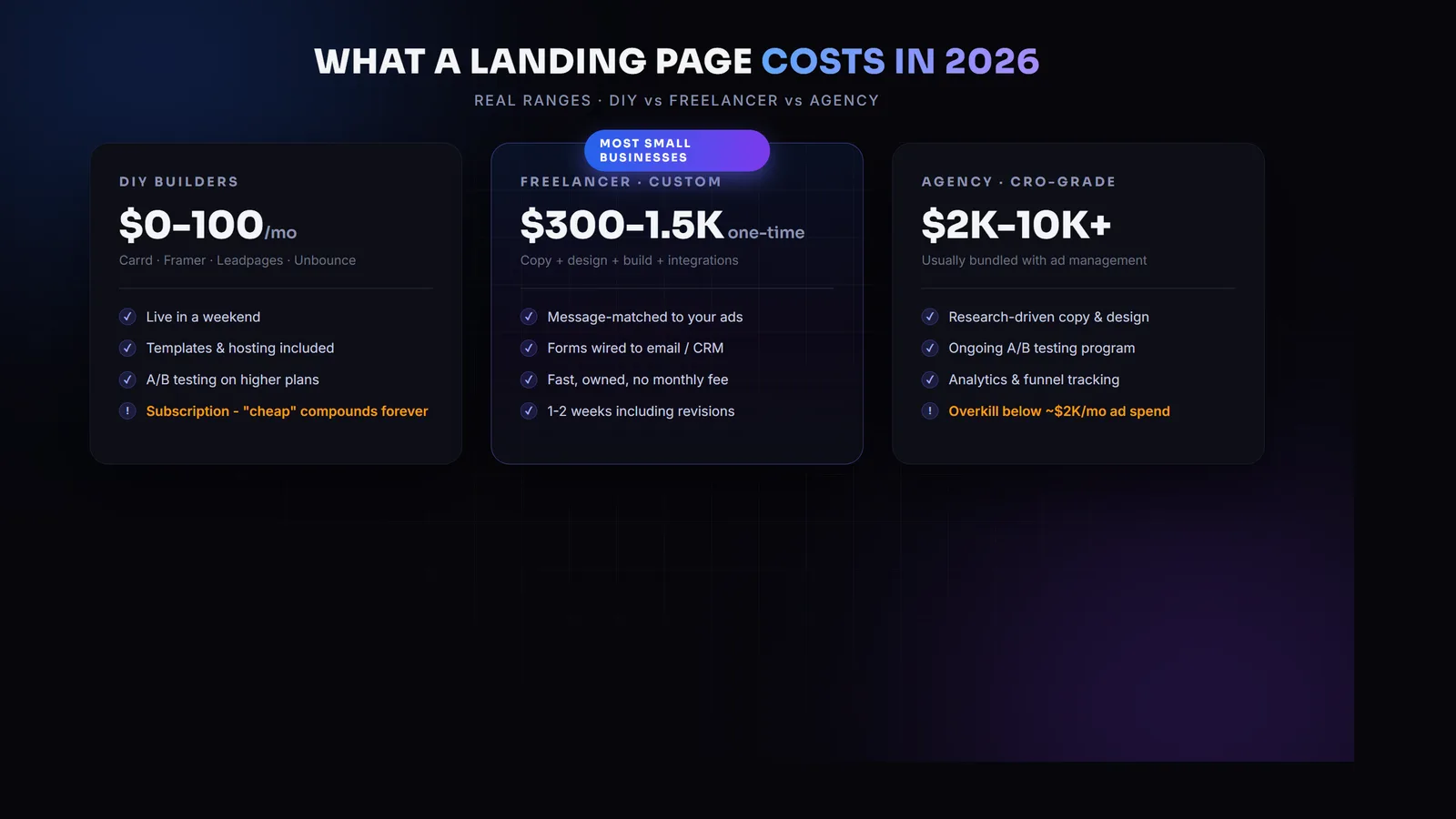
DIY builders: roughly $0 to $100 per month. Carrd starts around $19 per year, Framer and Webflow site plans run about $15-40 per month, and dedicated landing page platforms like Leadpages ($37-74/mo) or Unbounce ($74-99+/mo) charge more because A/B testing is built in. Note the pattern: builder landing pages are a subscription - "cheap" compounds monthly, forever.
Freelancer, custom-built: typically $300-$1,500 as a one-time cost depending on copy, design and integrations (forms, CRM, analytics, A/B variants). Agency / CRO-grade: $2,000-$10,000+, usually bundled with ad management and ongoing testing. For context on how that compares to bigger builds, see my transparent breakdowns of website costs, ecommerce store costs and web app development costs in 2026.
One honest note from the building side: the visual design is rarely what decides performance. The offer and the words do. A plain page with a sharp headline, real proof and a clear form will beat a beautiful page with vague copy every single time. Spend on the message before the polish.
How Many Landing Pages Should You Have?
One per distinct campaign, offer or audience - not one total. If you sell three services to two different audiences, that is potentially six focused pages, each mirroring the ad or email that feeds it. HubSpot's well-known research found businesses with 10-15+ landing pages generate dramatically more leads than those with fewer than five, and the reason is not magic: more pages means tighter message match and more chances to test what converts.
Practically: start with one per active campaign. Duplicate, tweak the headline and proof for each audience segment, and let the data tell you which angle wins. Retire losers without sentiment.
The 7 Landing Page Mistakes That Burn Ad Budgets
- 1Sending paid traffic to your homepage - the single most expensive habit in small-business advertising
- 2Leaving the site navigation on the page, giving every visitor ten polite ways to leave
- 3A headline that doesn't match the ad - visitors bounce in seconds when the promise changes
- 4Slow load times - paid visitors are the least patient traffic you will ever buy
- 5No proof - no reviews, no results, no logos, nothing that says other humans trusted you
- 6Asking for too much in the form - every extra field cuts completions; name, email and one qualifying question is usually enough
- 7No follow-up system - leads that wait days for a reply go cold; connect the form to email or a CRM the day the page goes live
Mistake #4 deserves special emphasis because you are paying per click: if the page takes four seconds to render, you bought a click and delivered a blank screen. The causes and fixes are the same as for any slow site - oversized images, bloated scripts, cheap hosting - all covered in why is my website so slow.
Landing Pages and SEO: The Part Everyone Gets Wrong
A common plan I hear: "we'll make twenty landing pages targeting twenty keywords and rank for all of them." That is not how it plays out. Campaign landing pages are thin and near-duplicate by nature - Google mostly ignores them, and a pile of them can drag down how it sees your whole site. Pages meant to rank need depth, internal links and a site around them; pages meant to convert ads need focus and no distractions. Different jobs, different pages.
The sustainable pattern: a fast website with genuinely useful pages earns the organic traffic, and noindexed campaign landing pages harvest the paid traffic. If organic is the goal, invest in the site's foundations - crawlability, speed, structure and content - which is exactly what my 2026 technical SEO checklist walks through item by item.
Quick Answers
Can a landing page be my whole website?
For a validation phase, an event or a single-offer business - yes, temporarily. But a one-page site and a landing page are not the same thing: a one-page website still has sections (about, services, contact) and tries to serve every visitor, which means it converts ads worse than a true landing page and ranks worse than a multi-page site. It is a compromise in both directions - fine to start, costly to stay.
What is a good landing page conversion rate?
Across widely cited industry benchmarks, the median sits somewhere between 4% and 7%, with top-decile pages converting well into double digits and plenty of mediocre pages stuck under 2%. Treat those numbers as orientation, not targets - a $5,000 service converting at 3% can be a far better business than a $19 product converting at 15%. Measure against your own economics.
Do landing pages work for Google Ads specifically?
They are close to mandatory. Google evaluates landing page experience as part of Quality Score, and Quality Score directly influences your cost per click and ad position. A focused, fast, relevant landing page per ad group is one of the few levers that improves results and lowers costs at the same time.
How long does it take to build one?
A DIY builder page: a weekend. A custom-built landing page with proper copy: about one to two weeks including revisions. A full website is a bigger project - I published honest phase-by-phase numbers in how long it takes to build a website in 2026.
The Bottom Line
Stop framing it as landing page versus website - they answer different questions. "Where do my paid clicks go?" is a landing page question. "Where do people research, compare and trust me?" is a website question. Validate with a landing page if you must move fast; build the website when trust and Google traffic start deciding your growth; and once you run ads seriously, run them into dedicated landing pages - never the homepage.
I build both sides of this system: fast, SEO-ready business websites and conversion-focused landing pages using Next.js - the same stack behind the projects in my portfolio. If you are deciding between a landing page, a website or both, tell me what you are trying to launch and I will give you a straight recommendation with a fixed quote - even if the honest answer is "start with the cheap option".
Written by
Ali Rehman - Freelance Web Developer
I work on WordPress websites, practical fixes and scoped web applications. Read my background and skill scope, or send a project brief to discuss a written plan and quote - start here.
More articles by Ali Rehman →